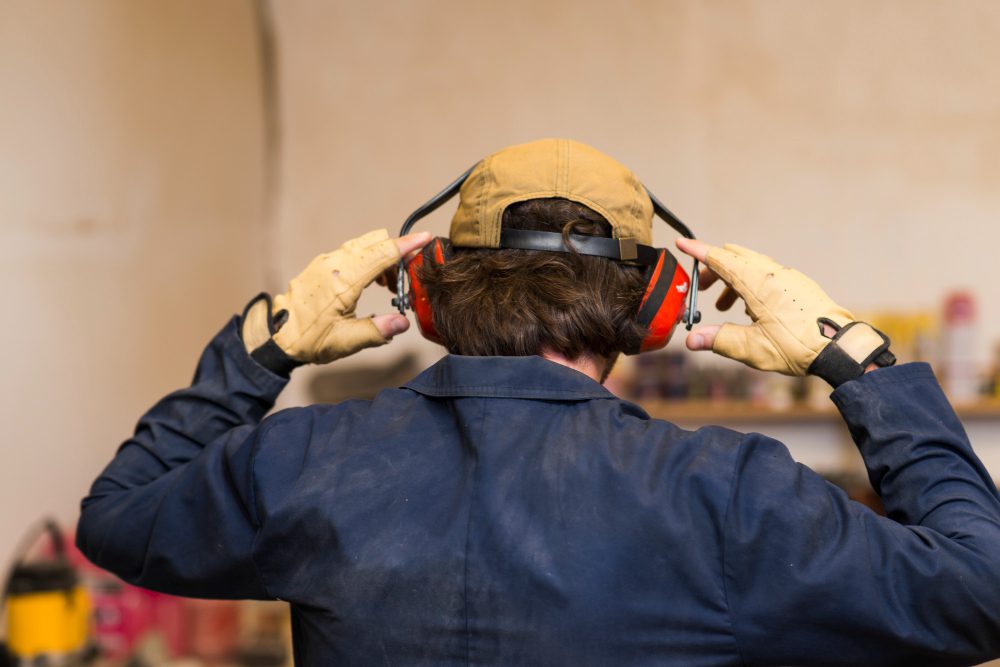
A site foreman for a large civil engineering project in Lagos sat down for dinner with his family after a twelve-hour shift. As his daughter spoke to him across the table, he found himself leaning in, struggling to distinguish her voice from the background hum of the refrigerator. To him, it felt like the “coffee shop effect”—that muffled, distant quality of sound you experience after a loud concert.
He dismissed it as fatigue. However, after twenty years of working near pile drivers, jackhammers, and circular saws without consistent protection, the “muffled” feeling wasn’t fatigue; it was the permanent death of the microscopic hair cells in his inner ear. He didn’t lose his hearing in a single explosion; he lost it decibel by decibel, one shift at a time.
In construction, hearing loss is often accepted as an “occupational tax.” At ADE Safety Consulting, we reject this notion. NIHL is 100% preventable through a combination of engineering discipline and administrative rigor.
I. The Physics of the Hazard: Understanding the Decibel Scale
To manage noise, safety leaders must first understand how it is measured. Sound intensity is measured in decibels (dB). Unlike a linear scale, the decibel scale is logarithmic. This means that an increase of only 3 dB represents a doubling of the sound energy.
OSHA’s Permissible Exposure Limit (PEL) is 90 dBA as an 8-hour Time-Weighted Average (TWA). However, NIOSH and other leading health organizations recommend a more conservative “Action Level” of 85 dBA. To put this in perspective:
- Normal Conversation: 60 dB
- Impact Drill: 100–105 dB (Safe exposure time: less than 1 hour)
- Jackhammer: 110 dB (Safe exposure time: less than 15 minutes)
- Pile Driver: 120+ dB (Threshold of pain; immediate damage possible)
When we audit a site, we look for “Acoustic Overload.” If a worker has to shout to be heard by someone standing three feet away, the noise level is likely above 85 dB, and a formal Noise Monitoring Program is required.
II. The Hierarchy of Controls: Moving Beyond the Earplug
The most common error in construction safety is jumping straight to Personal Protective Equipment (PPE). While earplugs are necessary, they are the least effective and most prone to failure. A textbook noise control strategy follows the Hierarchy of Controls.
1. Elimination and Substitution
Can we remove the noise source entirely? This might involve using a “hush” generator instead of a standard one or substituting a traditional jackhammer for a hydraulic “muncher” that crushes concrete with significantly less noise.
2. Engineering Controls (The “Hard” Barrier)
If the noise source cannot be removed, it must be isolated. This includes:
- Acoustic Enclosures: Placing temporary sound-dampening “blankets” or plywood enclosures around stationary equipment like compressors.
- Vibration Dampening: Using rubber mounts or pads under heavy machinery to prevent the metal-on-metal vibration that amplifies noise.
- Maintenance: A squealing belt or a grinding gear is often 10 dB louder than a well-lubricated one. Proper maintenance is a safety intervention.
III. Administrative Strategies: The Power of Distance and Time
If engineering controls are exhausted, we turn to administrative management. These are “simple” strategies that cost very little but offer massive protection.
The Rule of Double Distance:
Because of the “Inverse Square Law,” doubling your distance from a noise source reduces the sound pressure level by approximately 6 dB. By moving a generator 50 feet away from the main work zone instead of 25 feet, you significantly reduce the cumulative dose received by the crew.
Work Rotation (The Dose-Management Strategy):
Safety managers should treat noise exposure like a “daily dose.” If a worker must operate a high-decibel tool, they should be rotated to a “quiet” task for the remainder of the shift to allow the ears to recover from the temporary threshold shift.
IV. Selecting the Right PPE: NRR vs. Reality
When PPE is the only remaining option, the selection must be precise. Every hearing protector comes with a Noise Reduction Rating (NRR). However, the NRR is a laboratory number that rarely reflects field reality.
A common “Textbook” calculation used by safety professionals is to subtract 7 from the NRR and then divide by 2 to get the “Real-World” protection. If an earplug has an NRR of 30:
$$(30 – 7) / 2 = 11.5 \text{ dB of actual protection}$$
In high-noise environments (above 100 dB), Double Protection—wearing earplugs under earmuffs—is often required. This doesn’t double the NRR, but it adds a critical 5–10 dB of extra protection that can be the difference between safety and permanent damage.
V. The “Silent” Indicator: Audiometric Testing
How do you know if your noise control program is working? You measure the results. Clause 1910.95 requires an Audiometric Testing Program for all employees whose exposure equals or exceeds the 85 dB Action Level.
A textbook program includes:
- Baseline Audiogram: Taken within 6 months of an employee’s first exposure to establish their “normal” hearing.
- Annual Audiogram: To check for a Standard Threshold Shift (STS)—a permanent change in hearing of 10 dB or more.
If the annual audit shows an STS, it is a “System Failure.” It means your engineering controls, training, or PPE are not working, and the program must be overhauled immediately.
VI. Training and the “Soft” Skills of Safety
Finally, we must address the “macho” culture of construction. Many veteran workers view hearing protection as a nuisance or a sign of weakness. Training must move away from “rules” and toward “impact.”
We show workers that hearing loss isn’t just about “not hearing the radio.” It’s about Tinnitus—a permanent, maddening ringing in the ears—and the inability to hear high-frequency sounds, which are critical for understanding speech in a crowded room. When workers understand that their ability to engage with their families at the dinner table is at stake, compliance rates soar.
Conclusion: Preservation of a Vital Sense
Noise exposure control is a hallmark of a sophisticated construction operation. It shows that the leadership values the long-term quality of life of their employees as much as the daily production targets. By implementing simple engineering barriers, respecting the physics of distance, and insisting on verified PPE, you ensure that your workforce stays as sharp as your tools.
Is your site too loud for comfort? ADE Safety Consulting provides Noise Dosimetry, Acoustic Audits, and Hearing Conservation Training to keep your projects compliant and your people protected. Contact us today for a Site Noise Assessment.